Practical Effects in Horror: What They Are and Why They Still Matter
Practical effects in horror are the makeup, prosthetics, animatronics, and in-camera rigs built by hand and shot live on set, and they're the reason so many of horror's most disturbing images still hold up decades later. Unlike CGI, which gets built in post-production, practical work exists physically in the room with the actors and the camera while filming happens. HorroRated's curated practical FX in horror collection tracks the films that built their scares this way, from 1970s creature features through the genre's current practical-effects resurgence.
Key Takeaways
- Practical effects in horror are physical techniques (prosthetics, animatronics, puppetry, miniatures, in-camera rigs) created live on set and captured directly by the camera, not added digitally afterward.
- The genre's golden age of practical effects horror ran roughly from the late 1970s through the early 1990s, producing benchmark work like The Thing (1982) and An American Werewolf in London (1981).
- CGI became the industry default after Jurassic Park (1993) proved digital creatures could carry a feature film, and studio budgets shifted toward digital work through the 2000s and 2010s.
- Practical effects tend to age better in horror because physical materials interact with light and actors in ways CGI can struggle to replicate convincingly.
- 2024 marked a visible resurgence, with Terrifier 3, Nosferatu, The Substance, and Alien: Romulus all leaning heavily on practical work.
What Are Practical Effects in Horror?
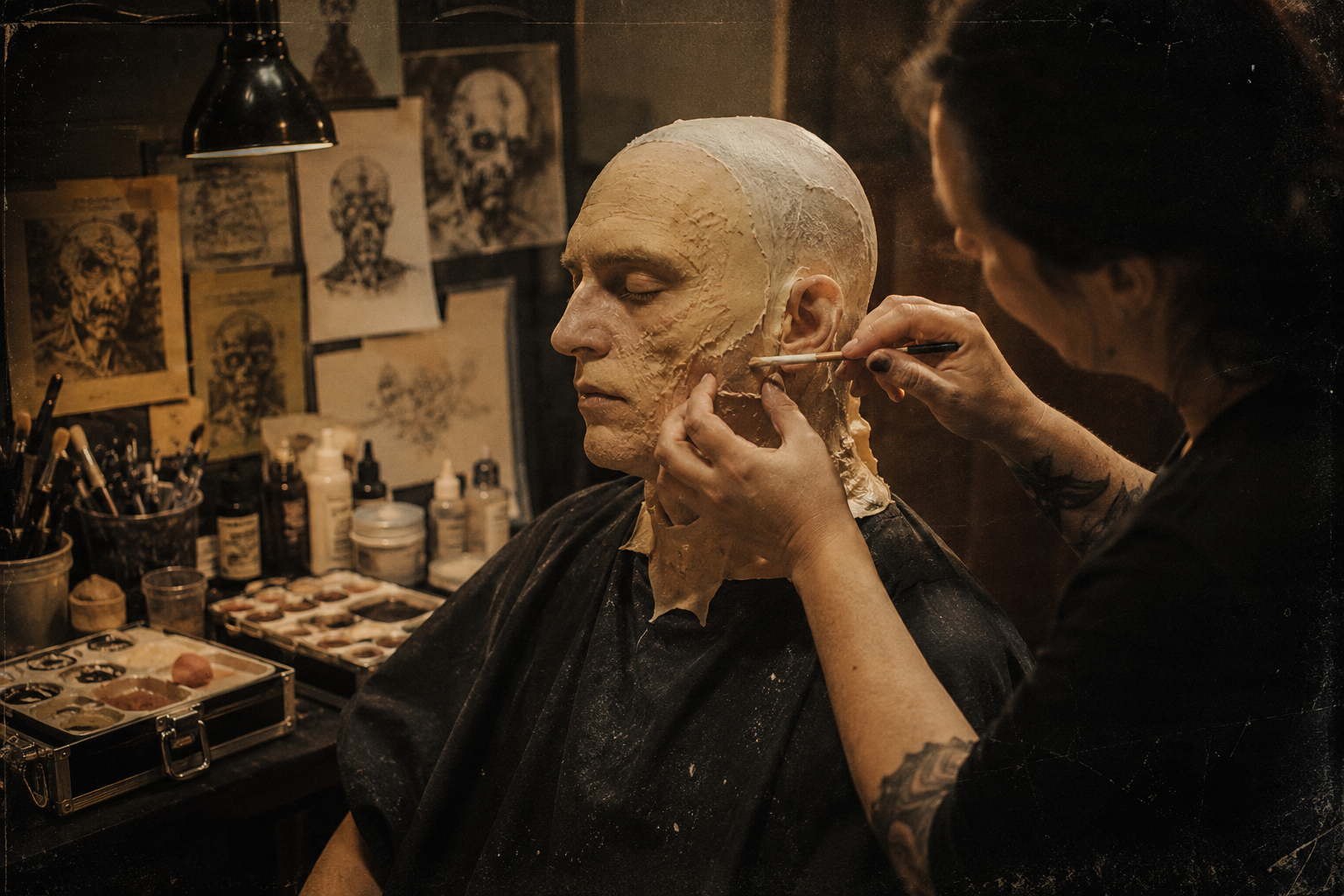
Practical effects are special effects created physically during filming rather than added digitally afterward. In horror specifically, that covers prosthetic makeup, animatronic creatures, latex suits, puppetry, fake blood rigs, and miniatures, all captured in-camera the moment a scene is shot. An actor reacting to a practical effect is reacting to something actually in the room with them, which is a big part of why the results tend to read as more convincing on screen.
The Techniques Behind Practical Effects in Horror
- Prosthetic makeup: silicone or foam latex appliances applied directly to an actor's skin to create wounds, transformations, or monstrous features.
- Animatronics: mechanical, often remote-controlled creatures with moving parts, used when an effect needs to move on cue.
- Puppetry: hand- or rod-operated creatures, useful for movements animatronics can't easily produce.
- Miniatures: scaled-down sets or models filmed to stand in for something too large or expensive to build full-size.
- In-camera rigs: mechanical blood gags, breakaway props, and pneumatic effects triggered live during a take.
Evil Dead II's puppetry and in-camera trickery is a useful reference point for how many of these techniques can stack inside a single low-budget production.
Practical Effects, Special Effects, and VFX: Clearing Up the Terms
The terms get used loosely. Special effects (SFX) is often shorthand for practical effects, meaning physical work done on set. Visual effects (VFX) covers anything added or altered digitally after filming, including CGI. Practical and digital work aren't mutually exclusive. Many modern productions shoot a practical effect on set, then use VFX to extend, clean up, or enhance it afterward. When people compare practical effects vs CGI in horror, they're really asking how much of the final image existed physically in front of the camera versus how much was built later on a computer.
Practical Effects vs. CGI in Horror: What's the Difference?
Practical effects vs CGI comes down to where the image gets created: on set in real time, or on a computer after the fact. Practical work is captured live in-camera using physical materials. CGI is generated digitally, usually in post-production, and composited into the shot. Horror leans on this distinction more than most genres because fear depends heavily on how believable a threat looks.
| Category | Practical Effects | CGI |
|---|---|---|
| Where it's created | On set, during filming | In post-production, on a computer |
| Physical interaction | Actors touch and react to a real object | Actors often react to nothing or a stand-in marker |
| Typical cost driver | Materials, build time, skilled crew | Software, render time, VFX artist hours |
| Aging | Ages by film stock and technique, often reads as timeless | Ages by rendering technology, can look dated quickly |
| Best suited for | Blood, tissue, texture, weight, actor interaction | Large-scale environments, physically impossible creatures, seamless extensions |
Why Practical Effects Tend to Age Better in Horror Specifically
CGI gets judged against the rendering technology of its moment, and that technology keeps changing, which is why digital effects from even ten years ago can look noticeably dated. Practical effects get judged against physical materials, lighting, and camera work, all of which are far more stable over time. A latex creature lit correctly in 1982 still reads as tactile and threatening in HorroRated's body horror collection today, while some digital work from the same decade hasn't aged nearly as well.
The Golden Age of Practical Effects Horror
The golden age of practical effects horror runs roughly from the late 1970s through the early 1990s, bookended by Dawn of the Dead (1978) on one end and Jurassic Park (1993) on the other, the film that proved CGI could carry an entire feature. In between, an unusually concentrated group of artists redefined what a horror monster could look like on screen.
The Artists Who Defined the Era
Rob Bottin's creature work on The Thing (1982) is still the benchmark most horror fans measure other practical effects against. Rick Baker won the first-ever Academy Award for Best Makeup for An American Werewolf in London (1981), and his transformation sequence remains the standard other werewolf films get compared to. Tom Savini, known for his work on Friday the 13th (1980) and Dawn of the Dead, brought a similarly hands-on approach to slasher gore that shaped the genre's visual language for a decade. HorroRated's entry on the practical effects work behind A Nightmare on Elm Street covers one of the era's more elaborate practical builds, a bedroom set constructed to rotate around a stationary camera for its blood-ceiling sequence.
What Changed When CGI Took Over
Jurassic Park's success taught studios that digital creatures could look convincing and, more importantly, could be cheaper to scale than building and maintaining physical rigs. Through the 1990s and 2000s, budgets shifted toward digital work, and a number of horror films leaned on CGI even in scenes where practical materials would have served the story better. Basket Case (1982) predates that shift by more than a decade, and HorroRated's entry on Basket Case's handmade creature effects is a good example of how much a low-budget production could accomplish with foam latex, puppetry, and a small crew willing to improvise.
The Best Practical Effects in Horror Films, Then and Now
Some films get cited in almost every practical effects conversation because the work is simply that good. This list mixes the expected classics with the current wave of films putting practical craft back at the center.
Classic Era Standouts
- The Thing (1982): Rob Bottin's creature effects, built on a large budget for its time, remain the most frequently cited benchmark in horror practical effects.
- An American Werewolf in London (1981): Rick Baker's transformation sequence won the first Academy Award for Best Makeup and is still the standard werewolf films get measured against.
- Alien (1979): H.R. Giger's Xenomorph design, built and operated practically, defined creature horror for a generation of filmmakers.
- Evil Dead II (1987): Sam Raimi's mix of puppetry, claymation, and in-camera trickery turned a low budget into a masterclass in improvisation.
- Army of Darkness (1992): The Evil Dead franchise's final chapter leaned even further into stop-motion skeletons and practical creature gags.
The Modern Practical Effects Revival
Practical effects never fully disappeared, but 2024 made the resurgence hard to ignore. Terrifier 3 built its reputation on over-the-top practical gore. The Substance used prosthetics and puppetry at a scale that recalled the genre's golden age. Nosferatu and Alien: Romulus both leaned on practical creature and makeup work rather than defaulting to CGI, and audiences noticed. For films built around exactly this kind of monster work, HorroRated's creature features collection is a good next stop.
Why Practical Effects Matter More in Horror Than Other Genres
Horror depends on physical dread in a way most other genres don't. A comedy or drama can still work if an effect looks slightly off, because the effect isn't doing the emotional work of the scene. In horror, the effect often is the scene, so how convincing it looks directly determines whether the moment lands.
That's also part of why horror carries a deeper collector culture around physical media and effects history than most genres. Fans track which sequel changed FX supervisors, which studio cut a creature's budget, and which franchise entry went digital too early. HorroRated's franchise timelines exist partly to make that kind of tracking easier, following how a series' effects choices shift from entry to entry.
How to Spot Practical Effects When You're Watching
You don't need a background in filmmaking to start noticing the difference. A few consistent tells separate practical work from digital effects once you know what to look for.
- Look for texture and imperfection. Practical materials like latex or foam catch light unevenly and show small surface flaws that digital surfaces rarely replicate by default.
- Watch how the actor's eyeline behaves. Actors reacting to a physical creature or prop tend to have more consistent, grounded eyelines than actors reacting to a tennis ball on a stick.
- Check whether shadows and reflections match. Practical objects cast shadows and pick up ambient light from the actual set, while poorly integrated CGI can look slightly disconnected from the scene's lighting.
- Notice movement weight. Puppets and animatronics move with real mechanical resistance, while digital creatures can move with a fluidity that feels lighter than their apparent mass suggests.
- Listen for behind-the-scenes context. Directors and effects artists who lean on practical work tend to talk about it in interviews, since it's usually a point of pride.
You can put this list to the test on the practical kill effects in Friday the 13th, one of the films most closely associated with Tom Savini's early gore work.
How HorroRated Curates Practical Effects Horror
HorroRated doesn't rank practical effects horror by algorithm or box office performance. Every entry gets a verdict from the team on a 0 to 5 scale, based on the actual viewing experience, not just the reputation of the effects work. That distinction matters because plenty of films get cited for a single famous practical effects scene despite being uneven overall. HorroRated's verdict system is built to separate the two, so a film with one incredible transformation sequence and a weak script gets scored honestly instead of inflated by its most famous scene.
Frequently Asked Questions About Practical Effects in Horror
What are practical effects in horror movies?
Practical effects in horror movies are physical techniques, including prosthetic makeup, animatronics, puppetry, and in-camera rigs, that are built and captured live on set rather than added digitally afterward. They range from a simple blood squib to a fully animatronic creature. Because they exist physically during filming, actors can react to them directly, which often reads as more convincing on screen.
What is the difference between practical effects and CGI?
Practical effects are created physically on set and captured directly by the camera. CGI is generated digitally, usually after filming, and composited into the shot in post-production. Many modern horror films combine both, shooting a practical effect on set and using CGI to extend or enhance it afterward.
Why do practical effects look more realistic than CGI in horror?
Practical effects are made from physical materials that interact naturally with light, shadow, and the actors around them, giving them a texture and weight CGI can struggle to replicate. Actors can also touch and react to a practical effect in real time, producing more grounded performances. CGI has closed much of that gap technically, but horror in particular still rewards the tactile, imperfect quality practical work provides.
What was the golden age of practical effects in horror?
The golden age of practical effects in horror runs roughly from the late 1970s through the early 1990s. Artists like Rob Bottin, Rick Baker, and Tom Savini defined the era with work on films including The Thing, An American Werewolf in London, and Friday the 13th, before Jurassic Park's success in 1993 shifted the industry toward digital effects.
Are practical effects making a comeback in horror?
Yes. 2024 saw a visible resurgence, with Terrifier 3, The Substance, Nosferatu, and Alien: Romulus all relying heavily on practical work instead of CGI. Filmmakers and audiences have both pushed back against over-reliance on digital effects, and studios have responded by funding more practical-forward productions.